

Deferred Accessibility Is an Architecture Defect, Not a Backlog Item
The most durable anti-pattern in product work is verifying accessibility after the interface already exists. Teams do not defer it out of malice. They defer it because they believe general craft instincts scale to cover everyone, and because the audit is already scheduled for the week before release.
The recall tax nobody budgets for
WCAG 2.2 carries dozens of success criteria. Layer platform behavior on top — the VoiceOver rotor, TalkBack swipe grammar, NVDA forms mode, the JAWS virtual cursor — and you are asking a designer to hold hundreds of conditional rules in working memory while also negotiating layout, motion, copy, error taxonomy, analytics events, and whatever sales was promised last quarter. Working memory loses that fight every time. The criteria that fall out first are the ones with no visual signal in a mockup: DOM reading order, programmatic labels, focus management inside overlays, live region politeness.
What that looks like at runtime
A transit app is the cleanest example because the failure has a body count in missed connections. An icon-only button shipped as <button><svg/></button> announces as button and nothing else. The departures board polls every fifteen seconds and swaps innerHTML inside a container marked aria-live='assertive', so a screen reader user gets interrupted mid-sentence four times a minute and never finishes reading the platform number. Worse, the status message injects into a node with no reserved height, so the primary CTA shifts down forty pixels. CLS on that route measured 0.31 in field data, and the tap aimed at Buy ticket landed on Cancel.
Remediation cost is where the real damage sits. Fixing reading order after launch means reordering the DOM, which means unwinding CSS Grid placement that was doing visual reordering, which means a full visual regression pass and a fresh round of stakeholder approval. A defect that cost twenty minutes during component design costs three sprints in month nine.
Swap Recall for Recognition, Then Put Recognition in the Repo
Nielsen had this solved decades ago. Recognition beats recall. The mechanical version of that heuristic is making each constraint visible at the exact moment the decision gets made, which means the constraint lives in the component spec and the test file rather than a compliance wiki.
Personas as component contracts
Accessibility personas earn their keep only when each one compiles down to something checkable. Vishnu at 400 percent zoom becomes a Playwright assertion that the component reflows inside a 320 CSS pixel viewport with no horizontal scroll and no clipped content. Emily, who points imprecisely and uses a switch, becomes a hard token — --target-min-size at 44px, with 24px as the absolute floor from criterion 2.5.8 — plus a lint rule that fails any drag interaction lacking a click and keyboard equivalent. Lea, managing chronic fatigue, becomes an interaction budget written into the story: a task completes in a stated number of inputs, no timeout fires under twenty minutes, and partial state survives a reload through a serialized snapshot. Trevor becomes a structural rule that error copy, label position, and action order stay identical across every form in the product.
Where the check actually executes
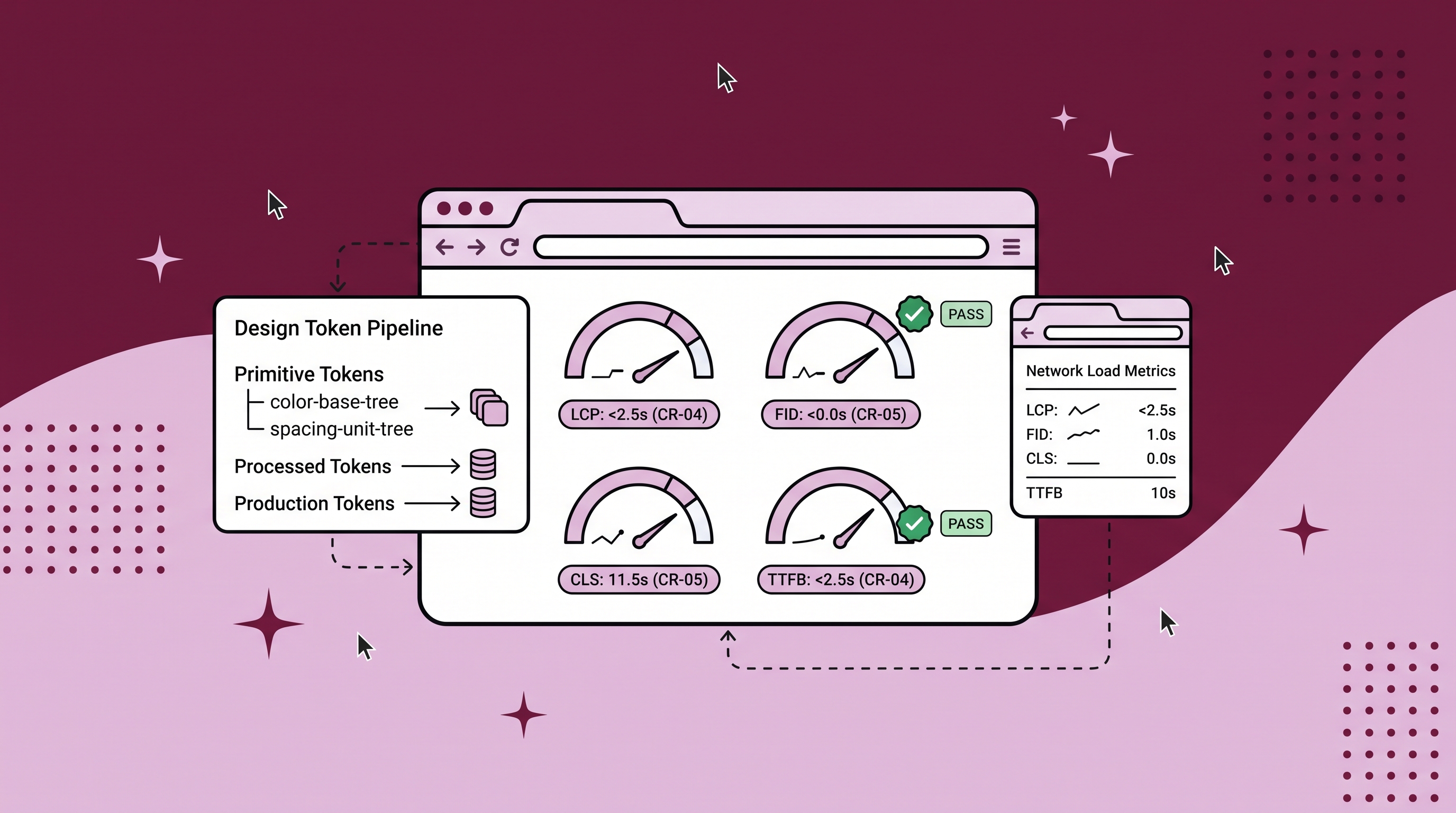
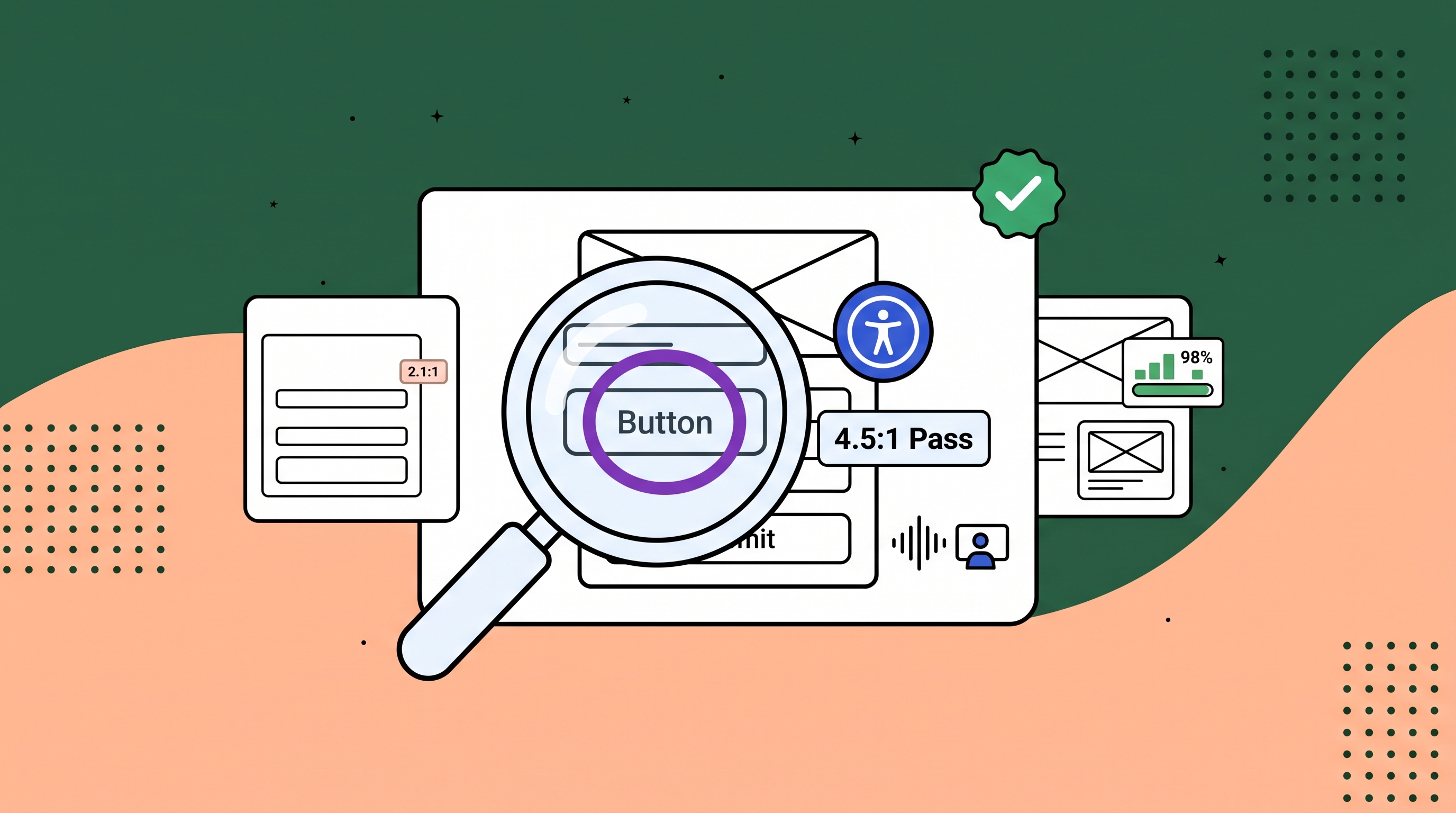
Run axe-core against every Storybook story and gate the pull request on it. Be honest about coverage — automated rules catch somewhere around a third of real defects and cannot tell you whether a label makes sense to a human, so any component whose interaction model changes also gets a manual persona pass. Contrast belongs in the token pipeline, not in review comments. Generate the pairing table at build time and fail the build when color.text.subtle drops below 4.5:1 against any surface it is allowed to sit on.
That pipeline has a cache invalidation problem people ignore. The token package publishes to npm, six applications consume it, and every one of them pins a minor version. A contrast fix in tokens reaches production only when each app bumps its lockfile, which historically takes eleven weeks. Treat a stale token version as an accessibility regression with an owner and a due date. The design side has the same lag — Figma serves a cached local library, so designers keep specifying last quarter’s focus ring for weeks after it changed.
Where Persona-Driven Work Starts Fighting Itself
Caricature is the first failure state
Flatten Vishnu into someone who zooms in and you lose most of the value. Low-vision users override your font stack, force prefers-contrast, and drive a magnifier whose visible window is roughly 300 pixels wide across a 1440 pixel canvas. Anything anchored bottom-right — the toast, the floating action button — sits permanently outside that window. The fix is structural, not cosmetic. Put status output adjacent to its trigger in the DOM and let CSS handle placement, so the magnifier viewport carries the user to the feedback automatically.
Density against reach
Enterprise operators want 28px rows and four hundred records on screen. Emily needs 44px hit areas. Averaging those produces a 36px row that serves neither group, which is the most common outcome I see in dashboard work. Ship a density scale instead — a compact tier that still honors the 24px floor and a comfortable tier that meets 44px — bound to a preference persisted server-side so it survives a device switch. The cost is measurable. Two density values across a ninety-component library roughly doubles the visual regression matrix, and a snapshot suite that ran eleven minutes now runs twenty-six. Scope density to the tables and toolbars where it changes outcomes, then freeze it everywhere else.
Predictability against novelty
Trevor’s requirement for stable structure collides directly with a redesign that hides navigation behind a hamburger at desktop width and replaces labels with icons. Motion is the same argument. A parallax hero that benchmarks beautifully at 60fps is a nausea trigger, and honoring prefers-reduced-motion is only cheap when duration and distance live in motion tokens. Hardcode those values into forty components and respecting one user preference becomes forty pull requests nobody schedules.
Making It Survive Contact With the Sprint
The designated dissenter
Assign one person per sprint to raise persona-shaped questions during refinement, before estimates get locked. Asking how Emily escapes a modal changes the estimate. Deferring the focus trap creates the forty-hour ticket that lands in month nine, usually the same week legal forwards a complaint. Naming the role matters more than the questions do, because it removes the social cost of being the person who slows the meeting down.
Personas non grata and boundary probes
Bowles gave us the adversarial counterpart, and its overlap with accessibility is larger than most teams expect. The CAPTCHA added to stop scrapers locks Vishnu out entirely. The rate limiter tuned to human typing speed rejects a switch user’s autocomplete macro as bot traffic. A five-minute session timeout set by the fraud team ends Lea’s checkout somewhere around step four. Encode each of those as a failing test rather than a paragraph in a policy document.
The outcome you want is unglamorous — axe violations trending to zero per pull request, CLS under 0.1 on routes carrying live regions, zero drag-only interactions in the library, a tested escape path on every overlay. None of that depends on anyone recalling a criterion number at 4pm on a Friday.