

The Expert Trap Compiles
Cognitive calcification does not stay in a designer’s head. It gets committed. When a senior skips discovery and reaches for the hero banner stacked on a carousel stacked on a three-column feature grid, that is not a taste problem. It is a structural decision the front-end team will be maintaining eighteen months from now, long after the person who made it moved to another squad.
What calcification looks like in the repository
The signature is easy to spot. There is a PageHero component carrying eleven optional props, most of them added under duress because some page refused to fit the pattern. There are breakpoint patches nested two deep. There is an absolutely positioned overlay compensating for text that overflowed a fixed-height container on a locale nobody tested. Somewhere in the tree sits a decorative image that never received aria-hidden because accessibility arrived at the end of the sprint as a Jira ticket titled a11y pass.
None of that is incompetence. It is what happens when a template is chosen before the problem is understood, and every subsequent commit becomes an apology for the original guess.
The bill arrives as CLS, not as a bad review
Carousels are the clearest case. A hero slide injected after hydration with no reserved aspect-ratio box will push the entire document down. On real product pages I have measured that shift at 0.28 against a Core Web Vitals budget of 0.1, which is a straight fail on the field data Google actually scores. The rotation script adds long tasks on mid-tier Android hardware, dragging INP past the 200ms threshold on the very interaction the carousel exists to encourage. Meanwhile the engagement data is brutal — traffic reaching anything past the first slide rounds to noise. A pattern that costs latency, layout stability, and maintenance burden is delivering a merchandising slot that mostly serves internal politics.
Replacing Intuition with Instrumented Constraints
The fix is not more empathy. It is a pipeline where field observation becomes a machine-readable input that outlives the researcher.
Contextual inquiry as a versioned artifact
Field notes belong in the repository, not in a deck. Sitting with physicists reading collision diagrams in a control room, you discover the ambient illuminance is under 40 lux and that analysts hold a single view for forty minutes without blinking properly. That observation becomes a record at research/constraints/control-room.md with an ID like CR-04. Every token and component that exists because of it carries that ID in a comment. Eight months later, an engineer who finds a suspiciously dark surface value can trace why it is there instead of normalizing it back toward the marketing palette.
Token architecture that survives the dark
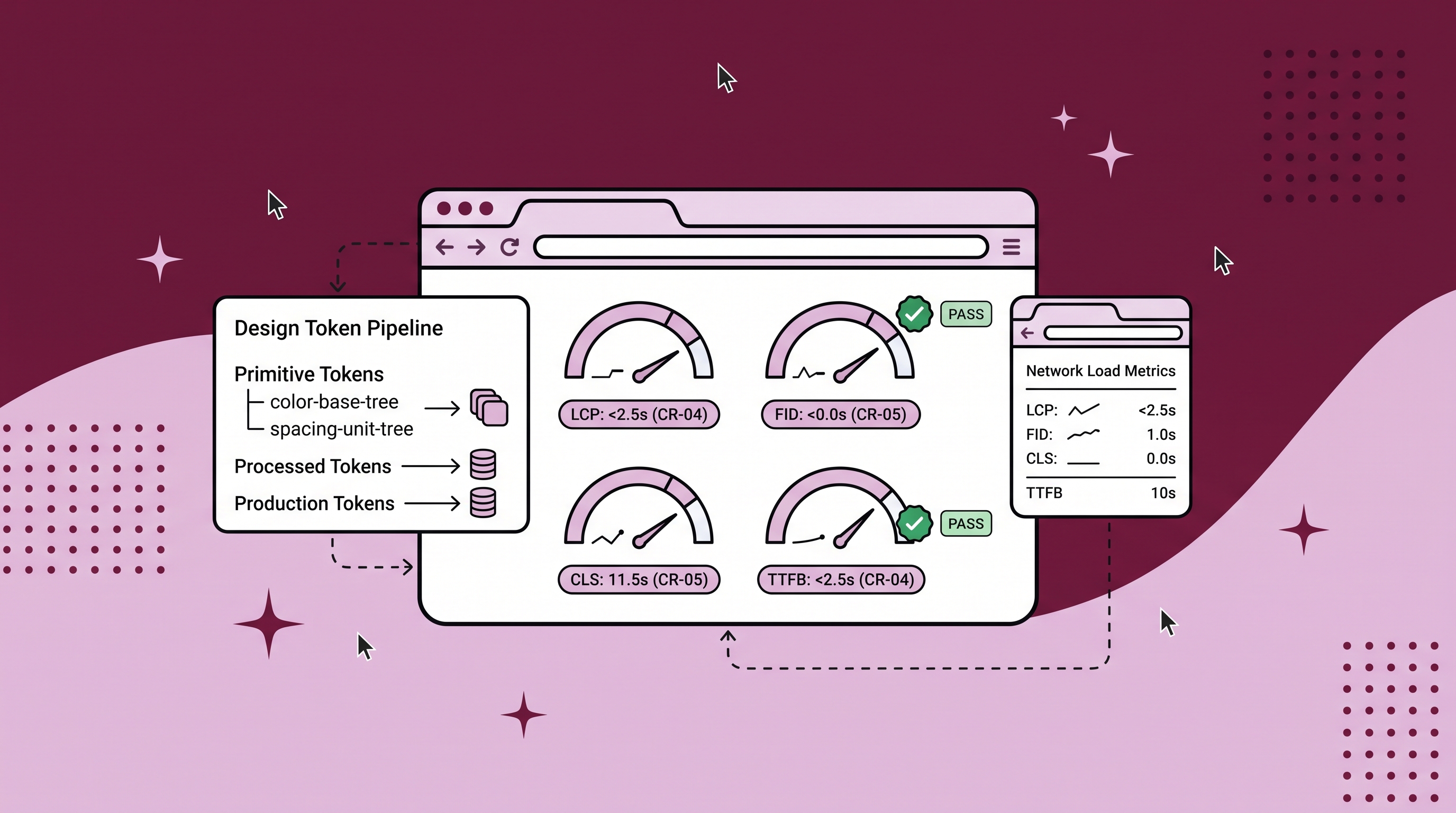
Dark mode is not filter: invert() and it is not a duplicated stylesheet. It is a theme dimension resolved at build time against a primitive layer, a semantic layer, and component-scoped overrides.
{ surface: { analysis: { value: '{color.base.slate-950}', constraint: 'CR-04' } } }
Compile that into custom property sets on :root[data-theme] and inline the theme-resolution script before first paint, otherwise you ship a flash of incorrect theme that reads as a broken build to anyone in a dim room. Cache invalidation is where teams quietly lose. If tokens ship as an unhashed vars.css on a short TTL, one value change forces a purge across every edge node and opens a window where cached HTML and fresh CSS disagree about contrast. Content-hash the compiled output, serve it immutable with a one-year max-age, and version the token package through semver so consumers upgrade deliberately.
Where Humility Fails Under Sprint Pressure
Research without a stop condition eats the quarter
Newly converted skeptics overcorrect into paralysis. The counter is a written stop condition, not willpower. Discovery ends when two consecutive sessions produce zero new constraint IDs. Saturation becomes a number a product manager can plan around, and the research budget gets capped in days rather than negotiated weekly.
Admitted ignorance can read as weakness
Stakeholders who treat designers as arbiters of certainty will hear I do not understand this domain yet as a confession. Never present a knowledge gap without an attached plan. Bring the constraint register, the open questions, and the named owner for each one. The transparency lands as rigor instead of drift.
Removing the flourish has a political price
Killing the carousel takes away a slot four teams were fighting over. If you do not replace it with a prioritized single placement backed by explicit rules, those teams route around you and inject banners through the tag manager. Now you have unmeasured third-party DOM mutation running after paint, which reintroduces the layout shift you removed and puts it outside your CI entirely. That is the worst failure state available.
The dark-first decision has its own edge cases. Low-luminance themes measurably degrade readability for some users with astigmatism, and they print badly for the regulatory reviews that scientific tooling always eventually requires. Ship the light theme as a peer of equal quality rather than a grudging fallback.
Making Humility Mechanical
Critique as a diff
Run critique against branched files with review threads attached to specific frames. The prompt is never whether people like it. The prompt is which constraint ID each decision serves and what evidence exists that it does. Where seniority distorts the room, post options without attribution and collect written feedback before anyone speaks.
Constraints enforced in CI, not in a workshop
- A
stylelintrule rejecting raw hex, magic pixel values, and any color declaration originating outside the token package. - Visual regression snapshots gating merges per component and per theme.
- A Lighthouse CI assertion per route holding CLS at 0.1 and LCP at 2.5s, failing the build rather than filing a ticket.
- An axe run against computed values from the resolved theme, confirming 4.5:1 on body text after token substitution rather than in the design file.
Automation catches roughly a third to a half of real accessibility defects. Keyboard traversal and screen reader passes stay manual, and any claim of full WCAG conformance needs assistive technology testing plus expert review before it goes in writing.
Outcomes that outrank taste
Instrument the workflow, not the aesthetic. Track median task completion on the primary path, error rate per thousand submissions, and the correction rate — users who edit a field within thirty seconds of entering it, a reliable proxy for a misread label. Watch support volume for two releases after launch. A design that wins the portfolio and loses the correction rate is a failure with good photography.